
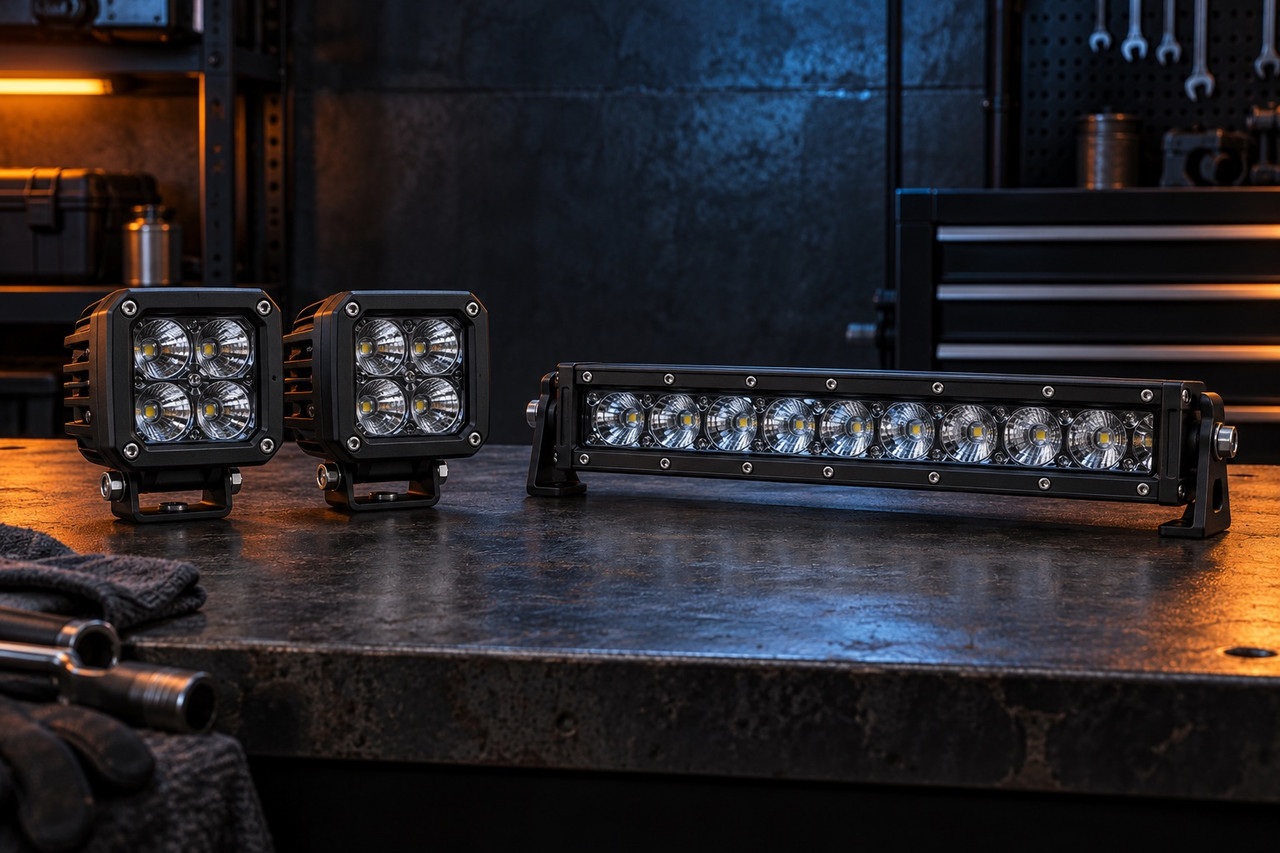
You have decided where your existing lighting falls short. Now comes the practical question: would a pair of compact pods or a light bar fit the job better? Start with the space on your vehicle and the area you need to illuminate. The shape of the housing is only part of the decision.
Start with the available mounting points
Measure the space allowed by the approved mounting kit. Include the bracket, fasteners, connector and room needed to adjust the lamp. A housing dimension alone does not describe the entire installed assembly. For example, a bar that fits between two body panels can still leave too little room for its cable connection.
Pods can offer separate mounting locations, while a bar packages its lamps into one wider housing. Neither arrangement guarantees easier installation. Compare the brackets supported by your exact vehicle, including accessories already occupying those mounting points.
Compare beam coverage separately from housing shape
A light bar is not automatically a flood light, and a pod is not automatically a spot. Read the beam description and look for the manufacturer’s distribution diagram. DENALI’s beam-pattern overview explains the difference between concentrated and wider distributions.
Imagine two uses: lighting the immediate area around a parked vehicle and supplementing visibility farther along an open trail. They call for different coverage. Match the optics to that job before comparing the total output numbers. Our lumens and reach guide explains what those numbers can tell you.
Compare the whole installation price
Put each option into a complete parts list: lights, brackets, wiring, switching and any required controller. Check whether the output and price describe one lamp, a pair or a complete package. Two listings with similar photographs may contain very different equipment.
If you are reusing a harness, verify that the manufacturer supports the proposed combination. A matching connector does not establish electrical compatibility. Use the stated electrical requirements and installation instructions rather than estimating demand from lumens.
Leave room for the vehicle to work
Check the clearances required by the mounting instructions, including opening panels, steering movement and access for maintenance. Consider whether you will need to remove the lights to reach a service point. Keep the intended control location in the plan as well.
Before ordering, write down the mounting-kit part number, beam type and missing installation components for each candidate. Compare Light Bars & Pods against that list. The useful choice is the one whose mounting, coverage and controls suit your actual setup.