
Articles & videos
Buying guides and install walkthroughs from the Velocity team, written against real parts in our catalog.
Featured
-
 UTV Soundbar or Complete Audio System?
-
 Light Pods or a Light Bar: Plan Your Mounting Space
-
 Planning an ATV or UTV accessory installation
-
 Choosing motorcycle luggage for the way you ride
-
 Before you wire auxiliary lights: plan the complete installation
-
 Lumens, beam pattern and reach: choosing auxiliary lights
-
 BMW X5 (E70) Factory HiFi vs. Top-HiFi: What a Plug-and-Play DSP Amp Changes
-
 2012 Chevrolet Tahoe Audio Upgrade: A Complete Walkthrough
-
 What’s in a Head Unit Install Kit (and Why You Need Every Piece)
-
 How to Choose Car Speakers
-
UTV Soundbar or Complete Audio System?
Illustrative concept image.
A soundbar and a complete UTV audio system can both put music in the cabin, but they organize the equipment differently. Before choosing, think about where people sit, where the controls will go and what is already attached to the vehicle. A system that looks compact in a product photograph may compete with a roof, windshield or mirror once installed.
Sketch the cabin f
-
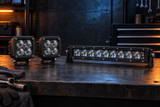
Light Pods or a Light Bar: Plan Your Mounting Space
Illustrative concept image.
You have decided where your existing lighting falls short. Now comes the practical question: would a pair of compact pods or a light bar fit the job better? Start with the space on your vehicle and the area you need to illuminate. The shape of the housing is only part of the decision.
Start with the available mounting points
Measure the space allowed by the approved mou
-
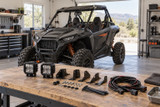
Planning an ATV or UTV accessory installation
Illustrative concept image.
Identify the vehicle you actually own
Begin with the exact year, make, model and trim, then note any equipment already installed. A vehicle family can include several configurations, and an accessory described as fitting that family may still have exceptions. Doors, roofs, windshields, racks and protection equipment can also change the space available for a new part.
Us
-
Choosing motorcycle luggage for the way you ride
Illustrative concept image.
Start with your usual trip
A daily commute and a week away ask different things of motorcycle luggage. Before comparing bag sizes, list what you actually carry. Separate the items you need during a ride from the items you only need when you stop for the night. That simple distinction helps determine both capacity and placement.
Think about the return trip too. A system
-
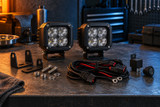
Before you wire auxiliary lights: plan the complete installation
Illustrative concept image.
Plan the system before the shopping cart
Auxiliary lights are one part of an installation. The mount holds them in position, the electrical components power and control them, and the routing keeps those components clear of moving or hot parts. Choosing those pieces together can prevent a purchase that looks complete but cannot be installed as intended.
Start with the ve
-
Lumens, beam pattern and reach: choosing auxiliary lights
Illustrative concept image.
Start with the area you need to see
A useful lighting upgrade begins with a specific problem. You may want to see farther along an open trail, illuminate the edges of a campsite, or improve the view immediately beside a vehicle. Those are different jobs. A large output number alone does not tell you which light will solve yours.
Write down where your existing lights fal
-
BMW X5 (E70) Factory HiFi vs. Top-HiFi: What a Plug-and-Play DSP Amp Changes
BMW badged more than one factory sound-system architecture as “HiFi” across the E70-generation X5, and the difference between them is not a minor trim detail — it determines which upgrade amplifier will work as a direct plug-and-play install, and which needs an additional bridge component.
HiFi (option 676): an analog factory system
The base factory HiFi system, BMW option code 6
-
 Speaker Wire and Power Wire Gauge Basics
Wire gauge shows up on almost every install-parts listing, and the numbering runs backward from what most people expect: a lower gauge number is a thicker wire, not a thinner one. Getting the gauge wrong does not usually make something fail outright, but it can mean real power loss or, at the extreme, a genuine heat and safety risk on a high-current power run.
Why thicker wire matters more as curr
Speaker Wire and Power Wire Gauge Basics
Wire gauge shows up on almost every install-parts listing, and the numbering runs backward from what most people expect: a lower gauge number is a thicker wire, not a thinner one. Getting the gauge wrong does not usually make something fail outright, but it can mean real power loss or, at the extreme, a genuine heat and safety risk on a high-current power run.
Why thicker wire matters more as curr
-
 Subwoofer Enclosures: Sealed vs. Ported vs. Powered
A subwoofer driver on its own is not a finished product — it needs an enclosure of some kind to control the air behind and in front of the cone, and the type of enclosure changes how the bass actually sounds. Here are the three approaches you will see across our catalog, and what each trades off.
Sealed enclosures: tighter, more accurate bass
A sealed enclosure is a fully closed airtight box
Subwoofer Enclosures: Sealed vs. Ported vs. Powered
A subwoofer driver on its own is not a finished product — it needs an enclosure of some kind to control the air behind and in front of the cone, and the type of enclosure changes how the bass actually sounds. Here are the three approaches you will see across our catalog, and what each trades off.
Sealed enclosures: tighter, more accurate bass
A sealed enclosure is a fully closed airtight box
-
 Upgrading a Factory Bose or GM Amplified System
Many GM trucks and SUVs, and a wide range of Bose-badged factory systems across other brands, ship with a factory amplifier built into the vehicle rather than into the head unit — hidden under a seat, behind a trim panel, or in the cargo area. That single fact changes several things about how an aftermarket upgrade needs to be wired, compared with a vehicle whose head unit drives the speaker
Upgrading a Factory Bose or GM Amplified System
Many GM trucks and SUVs, and a wide range of Bose-badged factory systems across other brands, ship with a factory amplifier built into the vehicle rather than into the head unit — hidden under a seat, behind a trim panel, or in the cargo area. That single fact changes several things about how an aftermarket upgrade needs to be wired, compared with a vehicle whose head unit drives the speaker
-
 Wired vs. Wireless CarPlay and Android Auto
Apple CarPlay and Android Auto both mirror a compatible phone’s navigation, music, and messaging apps onto a head unit’s screen, letting you use large touch controls and voice commands instead of your phone’s own smaller display. The core function is identical whether the connection is wired or wireless — the difference is entirely in how the phone and head unit talk to eac
Wired vs. Wireless CarPlay and Android Auto
Apple CarPlay and Android Auto both mirror a compatible phone’s navigation, music, and messaging apps onto a head unit’s screen, letting you use large touch controls and voice commands instead of your phone’s own smaller display. The core function is identical whether the connection is wired or wireless — the difference is entirely in how the phone and head unit talk to eac
-
 Single-DIN vs. Double-DIN Head Units
DIN is a chassis-size standard, not a marketing term — and confusing it with a feature tier is the most common reason a head unit that looked right on paper does not fit the dash.
What DIN actually measures
Single-DIN and double-DIN describe the physical height of a head unit’s chassis in a standardized radio-opening size: single-DIN is one standard slot, double-DIN is two stacked into
Single-DIN vs. Double-DIN Head Units
DIN is a chassis-size standard, not a marketing term — and confusing it with a feature tier is the most common reason a head unit that looked right on paper does not fit the dash.
What DIN actually measures
Single-DIN and double-DIN describe the physical height of a head unit’s chassis in a standardized radio-opening size: single-DIN is one standard slot, double-DIN is two stacked into
-
2012 Chevrolet Tahoe Audio Upgrade: A Complete Walkthrough
A 2012 Chevrolet Tahoe LT is one of the more common trucks we get asked about, and it is a good example of how a full audio upgrade breaks down into a handful of separate, location-specific decisions rather than one single purchase. Here is the complete picture, using this exact truck’s real application-guide data.
Five factory speaker locations, four different sizes
The Tahoe’s factor
-
What’s in a Head Unit Install Kit (and Why You Need Every Piece)
A new head unit rarely drops straight into a factory dash. The gap between a factory radio opening and a standard aftermarket chassis is closed by a small set of parts that, together, are usually called an install kit — and each one solves a specific, physical problem. Here is what each part does, using the real parts a 2012 Chevrolet Tahoe LT needs as a working example.
The dash kit: closin
-
 Do I Need an Amplifier?
This is the single most common question after a speaker upgrade, and the honest answer is: it depends on what the speaker is rated for and what is already powering it. Here is how to work it out using real numbers instead of guessing.
Every factory head unit already has an amplifier built in
A factory radio is not a passive box — it has a small amplifier stage built into the chassis, typical
Do I Need an Amplifier?
This is the single most common question after a speaker upgrade, and the honest answer is: it depends on what the speaker is rated for and what is already powering it. Here is how to work it out using real numbers instead of guessing.
Every factory head unit already has an amplifier built in
A factory radio is not a passive box — it has a small amplifier stage built into the chassis, typical
-
 Speaker Sizes Explained: 6.5″ vs 6.75″ vs 6x9″, Depth, and Tweeter Pods
Speaker size labels look like they should be simple — a number and a unit — but a few fractions of an inch, or a completely different shape, decide whether a speaker bolts into your factory opening or sits on a shelf.
6.5" and 6.75" are not interchangeable
These two sizes are close enough to cause real confusion, but they describe different mounting-hole diameters and differe
Speaker Sizes Explained: 6.5″ vs 6.75″ vs 6x9″, Depth, and Tweeter Pods
Speaker size labels look like they should be simple — a number and a unit — but a few fractions of an inch, or a completely different shape, decide whether a speaker bolts into your factory opening or sits on a shelf.
6.5" and 6.75" are not interchangeable
These two sizes are close enough to cause real confusion, but they describe different mounting-hole diameters and differe
-
 Component vs. Coaxial Speakers
Both coaxial and component speakers ultimately do the same job — reproduce a full range of frequencies from a single mounting location — but they get there in fundamentally different ways, and that difference affects both installation and sound.
Coaxial: everything on one basket
A coaxial speaker mounts a tweeter directly on top of a larger woofer’s frame, combining full-range ou
Component vs. Coaxial Speakers
Both coaxial and component speakers ultimately do the same job — reproduce a full range of frequencies from a single mounting location — but they get there in fundamentally different ways, and that difference affects both installation and sound.
Coaxial: everything on one basket
A coaxial speaker mounts a tweeter directly on top of a larger woofer’s frame, combining full-range ou
-
How to Choose Car Speakers
Most factory speakers fail the same way: the cone surround dries out, the voice coil rubs, or the paper cone just gives up after a decade of heat-cycling in a door panel. The fix is rarely complicated, but the spec sheet on a replacement speaker can look like a wall of numbers with no obvious meaning. Here is what actually matters and why, using real listings from our catalog.
Start with the size,
No articles match that topic yet.